








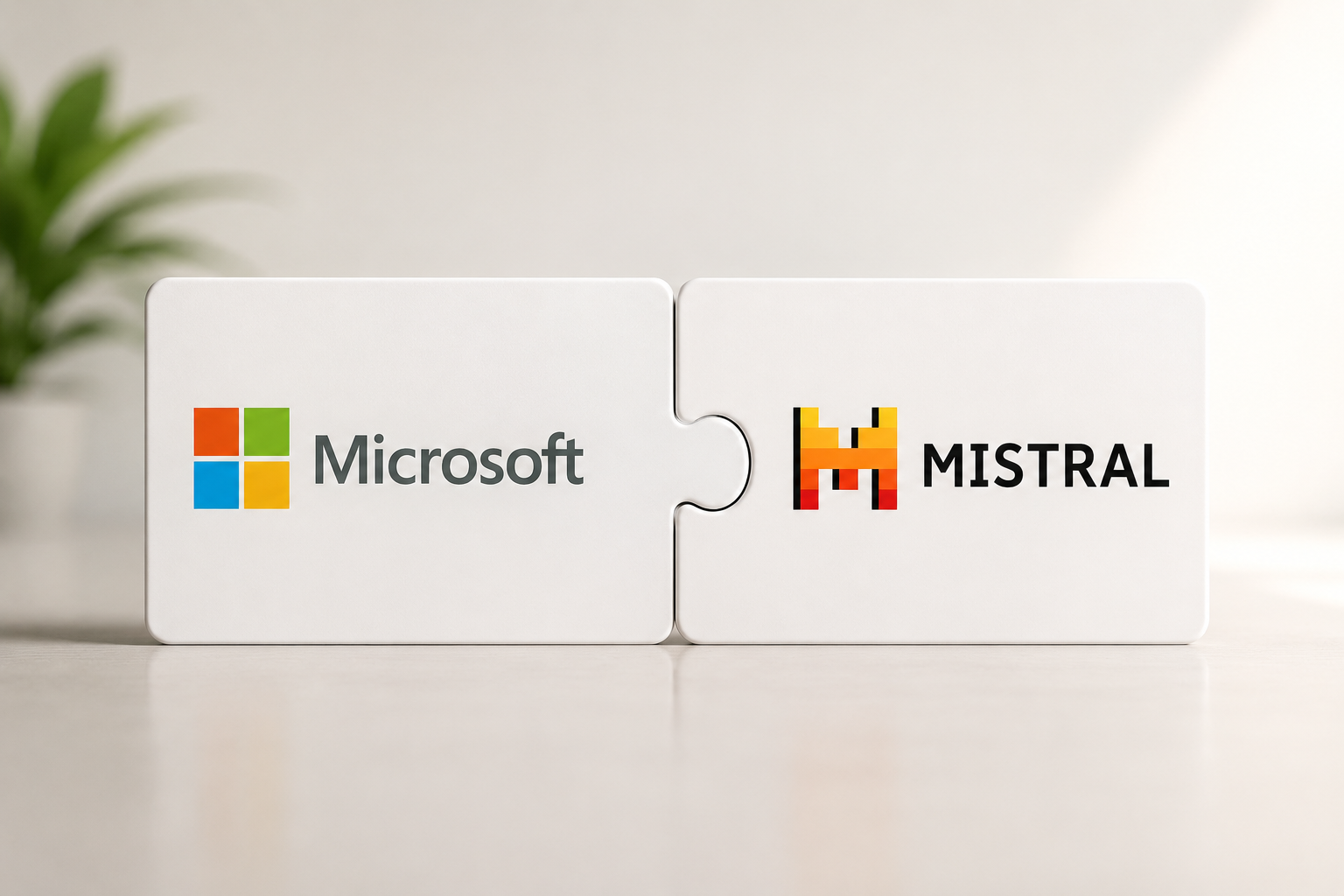
Microsoft is strengthening its position in the global artificial intelligence race through an expanded Microsoft Mistral partnership that focuses on enterprise AI, sovereign cloud infrastructure, and Europe’s growing demand for secure AI deployment. The two companies have announced a major strategic expansion that combines Microsoft’s cloud ecosystem with Mistral’s advanced AI models and computing infrastructure, giving businesses greater flexibility in how they build and operate AI applications.
The agreement goes beyond simply making AI models available on Azure. It includes a multibillion-dollar infrastructure commitment, broader integration of Mistral’s latest models into Microsoft’s AI platform, and new deployment options designed specifically for organisations operating in highly regulated industries such as healthcare, finance, manufacturing, and government.
Microsoft Deepens Its Commitment to European AI
The expanded collaboration marks another important milestone in Microsoft’s long-term investment strategy across Europe.
As demand for generative AI continues to increase, enterprises are looking for infrastructure that delivers high performance while meeting strict requirements around data privacy, security, and operational control. Microsoft believes European organisations should have access to advanced AI technologies without losing control over where their data is stored or how critical systems are managed.
To support that goal, Microsoft will utilise a portion of Mistral’s expanding GPU infrastructure in Europe. The agreement represents a multibillion-dollar investment that increases AI computing capacity while helping Microsoft meet rapidly growing demand for cloud-based AI services across the region.
The move also supports Microsoft’s broader commitment to strengthening Europe’s digital infrastructure and reducing dependence on AI resources located outside the continent.
Who Is Mistral AI?
Founded in 2023 and headquartered in Paris, Mistral has quickly become one of Europe’s fastest-growing artificial intelligence companies.
The startup is known for developing powerful multilingual large language models designed to compete with leading AI systems from OpenAI, Anthropic, Google, and Meta.
Unlike many AI companies, Mistral places significant emphasis on openness, efficiency, and enterprise flexibility. Its models are designed to perform advanced reasoning tasks while giving organisations more options for deployment and operational control.
The company has attracted substantial investment from global technology firms and investors, positioning itself as one of Europe’s strongest competitors in the frontier AI market.
Mistral Models Become Part of Microsoft’s AI Ecosystem
One of the most significant announcements within the Microsoft Mistral partnership is the broader availability of Mistral’s latest AI models across Microsoft’s enterprise platforms.
The company’s newest Medium 3.5 language model and OCR 4 document-processing model are now integrated into Microsoft Foundry, allowing developers to build AI applications using Microsoft’s existing development environment.
At the same time, Medium 3.5 has also been introduced into Microsoft Copilot Studio, giving organisations another model choice when building intelligent assistants, automation workflows, and enterprise copilots.
Rather than forcing customers to rely on a single AI provider, Microsoft continues expanding its platform by offering multiple model families, allowing businesses to select the technology best suited to their workloads.
Why This Partnership Matters for Enterprise Customers
Many organisations adopting AI are no longer asking whether they should use artificial intelligence they are asking where it should run and how much operational control they can maintain.
For industries handling sensitive information, simply hosting AI workloads in a public cloud is often not enough.
The expanded Microsoft-Mistral collaboration directly addresses this challenge by giving customers multiple deployment options while maintaining a consistent development experience.
Businesses can now choose between:
- Traditional Azure cloud deployments.
- Cloud-connected private infrastructure.
- Fully disconnected on-premises environments.
This flexibility enables organisations to meet internal security policies, regulatory obligations, and operational requirements without redesigning their AI applications for different environments.
A Stronger AI Infrastructure Powered by NVIDIA
Supporting the partnership is a significant expansion of Mistral’s computing infrastructure.
The company plans to deploy thousands of NVIDIA Vera Rubin GPUs, one of NVIDIA’s latest AI computing platforms designed for large-scale model training and inference.
The additional computing power will strengthen Europe’s AI infrastructure while providing Microsoft with greater capacity to support enterprise AI workloads, advanced reasoning models, and increasingly complex AI applications.
The investment reflects growing demand for specialised AI hardware as businesses continue integrating generative AI into everyday operations.
Microsoft Foundry Simplifies AI Development
Alongside the infrastructure announcement, Microsoft is continuing to strengthen Microsoft Foundry, its unified platform for discovering, building, customising, and deploying AI models.
Developers can access different AI models within a single environment while using familiar APIs, tools, and workflows.
Instead of rebuilding applications every time deployment requirements change, teams can develop once and deploy across multiple environments with minimal adjustments.
This reduces development complexity while giving organisations greater flexibility as AI projects move from experimentation into production.
Azure Local Brings More Flexibility for AI Deployments
One of the biggest highlights of the expanded Microsoft Mistral partnership is the ability to deploy AI applications across different operating environments without changing development workflows.
Microsoft says organisations can now build AI solutions using the same tools and later decide where those applications should run based on security, compliance, and operational needs.
The company offers three deployment models:
- Azure Cloud, designed for organisations that want maximum scalability and continuous platform updates.
- Cloud-connected Azure Local, where businesses maintain greater operational control while remaining connected to Azure services.
- Fully disconnected Azure Local, created for highly sensitive environments that must operate independently from external networks.
This unified deployment strategy allows enterprises to maintain consistent AI operations while meeting industry-specific regulatory requirements.
Why Regulated Industries Stand to Benefit
Many sectors cannot rely entirely on public cloud infrastructure because they manage highly sensitive information.
Through the expanded partnership, Microsoft and Mistral aim to make advanced AI more practical for organisations operating under strict compliance frameworks.
Healthcare
Hospitals and healthcare providers can process clinical information within controlled environments while supporting AI-assisted documentation, diagnostics, and administrative workflows without compromising patient privacy.
Financial Services
Banks and financial institutions can deploy AI solutions that assist with fraud detection, compliance monitoring, customer service, and risk analysis while maintaining tight control over sensitive financial information.
Manufacturing
Industrial organisations can analyse production data, automate quality inspections, optimise supply chains, and improve operational efficiency while keeping proprietary manufacturing data inside their own infrastructure.
Government and Public Sector
Public institutions responsible for critical services can introduce AI into mission-critical operations while maintaining national security, operational resilience, and data sovereignty.
Europe’s AI Sovereignty Strategy
The partnership also reflects Europe’s broader ambition to strengthen its own AI ecosystem.
In recent years, European policymakers have encouraged greater investment in regional AI infrastructure to reduce dependence on overseas technology providers and give organisations more control over digital assets.
By combining Microsoft’s enterprise cloud platform with Mistral’s European-developed AI models and expanding GPU infrastructure within Europe, both companies aim to support customers seeking powerful AI capabilities without sacrificing operational independence.
This approach aligns with Microsoft’s long-term European digital commitments while supporting the region’s growing demand for trusted AI infrastructure.
Enterprise AI Is Becoming More Flexible
Rather than offering only one AI model, Microsoft continues expanding its ecosystem by providing customers with multiple options.
Developers using Microsoft Foundry can now choose from different frontier models depending on their workloads, performance requirements, language support, and deployment preferences.
This flexibility reduces vendor lock-in and allows organisations to adopt AI strategies that best fit their technical and business objectives.
As enterprises increasingly build AI-powered applications, having access to multiple high-performance models within a single platform could become a major competitive advantage.
Microsoft and Mistral Plan to Accelerate AI Adoption
Beyond technology integration, the two companies are also expanding their commercial collaboration.
Microsoft and Mistral will jointly support enterprise customers through proof-of-concept programs, technical workshops, Azure credits, and broader go-to-market initiatives designed to speed up AI adoption.
These efforts will help organisations evaluate frontier AI solutions before moving large-scale projects into production, reducing both technical complexity and implementation risks.
The collaboration also gives businesses direct access to expertise from both companies as they develop AI strategies tailored to industry-specific requirements.
What This Partnership Means for the AI Industry
The expanded agreement highlights an important shift in the global AI market.
Until recently, much of the conversation focused on building increasingly powerful language models. Today, the emphasis is expanding toward the infrastructure, deployment flexibility, governance, and operational control required to run those models securely at scale.
Microsoft’s decision to deepen its collaboration with Mistral demonstrates that enterprise customers are demanding more than raw model performance. They also want flexibility, compliance, resilience, and greater control over where AI operates.
As competition intensifies among Microsoft, Google, OpenAI, Anthropic, Meta, and emerging European AI companies, partnerships like this are expected to play an increasingly important role in shaping the next phase of enterprise artificial intelligence.
Why It Matters
The expanded Microsoft Mistral partnership represents far more than another technology agreement. It combines AI infrastructure, enterprise software, and flexible deployment options into a unified strategy designed for organisations operating in increasingly complex regulatory environments.
By integrating Mistral’s frontier AI models across Azure, Microsoft Foundry, and Copilot Studio while investing in Europe’s AI infrastructure, Microsoft is strengthening its enterprise AI ecosystem and giving businesses more choice over how they develop, deploy, and manage artificial intelligence.
As AI adoption continues accelerating across industries, partnerships focused on security, operational control, and scalable infrastructure are likely to become just as important as advances in the models themselves.
Frequently Asked Questions
What is the Microsoft Mistral partnership?
It is an expanded strategic collaboration that brings Mistral’s AI models to Microsoft Foundry, Copilot Studio, and Azure while strengthening AI infrastructure across Europe.
Why is Microsoft investing in Mistral’s infrastructure?
The investment helps increase AI computing capacity in Europe, supports growing enterprise demand for AI services, and strengthens Microsoft’s regional cloud infrastructure.
Which Mistral models are now available on Microsoft platforms?
Mistral Medium 3.5 and OCR 4 are available through Microsoft Foundry, while Medium 3.5 has also been integrated into Microsoft Copilot Studio.
What industries benefit from this partnership?
Healthcare, financial services, manufacturing, government agencies, and other regulated industries that require secure and flexible AI deployment options.
What is Azure Local?
Azure Local allows organisations to run AI applications within their own environments while maintaining compatibility with Microsoft’s broader Azure ecosystem.