










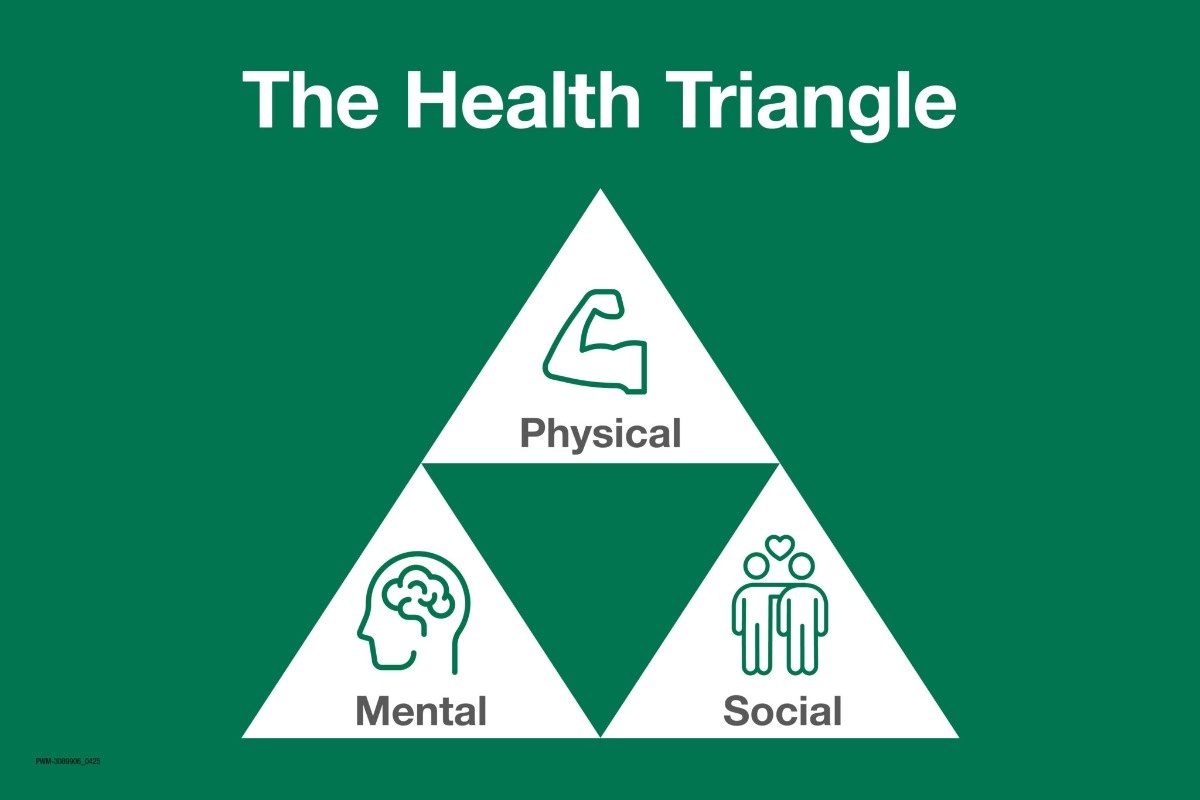
People usually think about health in terms of physical fitness and diet. If you can run a mile and eat your veg, you are healthy, right? Not exactly. While fitness is one component of health, it is not the most important one. True health comes from knowing and nurturing the health triangle. \n\nThe health triangle is a concept used to explain total wellbeing, and the importance of equilibrium. The health triangle suggests that to achieve total wellbeing, you need a balanced equilibrium among your physical, mental/emotional, and social health. If you neglect any one area, it will become destabilized.\n\nThis will help you to understand the health triangle, the importance of equilibrium, and how you can help strengthen any one side, to help you live a more joyous and healthier life.
What Is the Health Triangle?
People who teach about health often use the Health Triangle to help people see health more holistically. Picture the Health Triangle as a triangle with all three sides equal. This represents the kind of state of health in which the social, mental, and physical health aspects are balanced and receiving the attention they need.
If you’re working (mental) but not socializing with your friends (social), or you’re not sleeping (physical), the triangle will become unbalanced. An unbalanced triangle is going to collapse. The idea is not to maintain an equal balance in everything every day, but to keep consistent work on each of those sides.
The Three Sides of the Health Triangle
To balance your life, you first need to understand the distinct requirements of each side.
Physical Health
This is the side most people recognize immediately. Physical health refers to the condition of your body and how well it functions. It involves more than just the absence of disease; it includes your energy levels, physical strength, and resistance to illness.
Good physical health typically requires:
- Regular Exercise: Moving your body keeps your heart strong and muscles toned.
- Nutritious Diet: Fueling your system with balanced meals provides the energy you need to function.
- Adequate Sleep: Your body repairs itself during sleep, making 7-9 hours crucial.
- Hygiene: Basic habits like brushing teeth and washing hands prevent infections.
Mental and Emotional Health
The second side of the health triangle deals with your mind and feelings. Mental health involves your ability to process information and cope with reality, while emotional health focuses on how you express feelings and manage stress.
A person with strong mental and emotional health generally:
- Accepts Responsibility: They take ownership of their actions and mistakes.
- Manages Stress: They have healthy coping mechanisms for life’s challenges.
- Expresses Emotions: They can articulate feelings like anger, joy, and sadness in constructive ways.
- Maintains a Positive Outlook: They generally view life with optimism, even during tough times.
Social Health
The final side is social health, which is often the most overlooked. This aspect measures the quality of your relationships with others. It isn’t about how many friends you have, but rather how you interact with people and navigate social environments.
Healthy social habits include:
- Communication: Listening effectively and speaking clearly.
- Respect: Treating others with dignity and respecting their boundaries.
- Support Networks: Having family or friends you can rely on during difficult times.
- Empathy: Understanding and sharing the feelings of others.
Why Balance is Essential
Why does shape matter? Because the sides are all connected.
Think about having the flu. You would probably feel gross and grumpy, which would make you not want to hang out with friends. The same thing happens when you are going through a bad breakup. You might stop sleeping and lose your appetite due to the breakup.
All three sides of the health triangle need to be in balance to stay healthy. Exercise will help you feel good because it releases endorphins. Having friends will help you feel better because you won’t be as mentally stressed. Having a good balance of all three will help you feel better.
Actionable Tips to Improve Your Health Triangle
You don’t need to overhaul your entire life overnight. Small, consistent changes yield the best results. Here are practical ways to strengthen each side.
Strengthening Physical Health
- Start Small: Commit to a 20-minute walk three times a week.
- Hydrate: Swap one sugary drink for a glass of water daily.
- Prioritise Rest: Set a “lights out” time for your electronics 30 minutes before bed to improve sleep quality.
Boosting Mental and Emotional Health
- Practice Mindfulness: Spend five minutes a day focusing on your breathing or journaling your thoughts.
- Learn Something New: Challenge your brain with a puzzle, a book, or a new hobby.
- Seek Help: If stress feels unmanageable, talking to a counsellor is a sign of strength, not weakness.
Enhancing Social Health
- Disconnect to Connect: Put your phone away during dinner to focus on the people physically present with you.
- Join a Group: Find a club or class that aligns with your interests to meet like-minded people.
- Set Boundaries: Learn to say “no” to social obligations that drain you, so you can give your best energy to the relationships that matter.
Conclusion
Your health is always changing. It’s not about getting to one finish line. The health triangle shows that being truly healthy is about how we view health as a whole. Give yourself, your mind, and your relationships equal care, and you will create a life that is healthy, satisfying, and strong. Look at your triangle today. Where could you give a little more support? That is where you should start, and you will see your wellness improve.